Local AI buying guide

Best AI PCs and workstations for local LLMs

Compare complete AI computers by the models that fit in fast memory, their storage and networking options, and the tradeoffs they make in speed, footprint, noise, and upgradeability.

The key decision

Large memory pool or maximum GPU bandwidth?

Unified memory: fit more model

A 64 to 128 GB shared pool can hold large quantized models. It is compact and capacity-focused, but typically does not match a large discrete GPU's inference speed.

Best fit: capacity-focused 32B to 70BCompare AI mini PCs

Discrete GPU: maximize speed

32 GB of dedicated VRAM and high memory bandwidth are excellent when the model fits entirely on the GPU. 70B usually requires CPU/RAM offloading or stronger quantization.

Best fit: fast 8B to 32B workflows

AI appliance: integrated software stack

A specialized NVIDIA system can combine a large unified pool with CUDA tools. In return, plan for an Arm processor, Linux, and a machine designed more for AI development than general Windows desktop use.

Best fit: CUDA-native development and large models
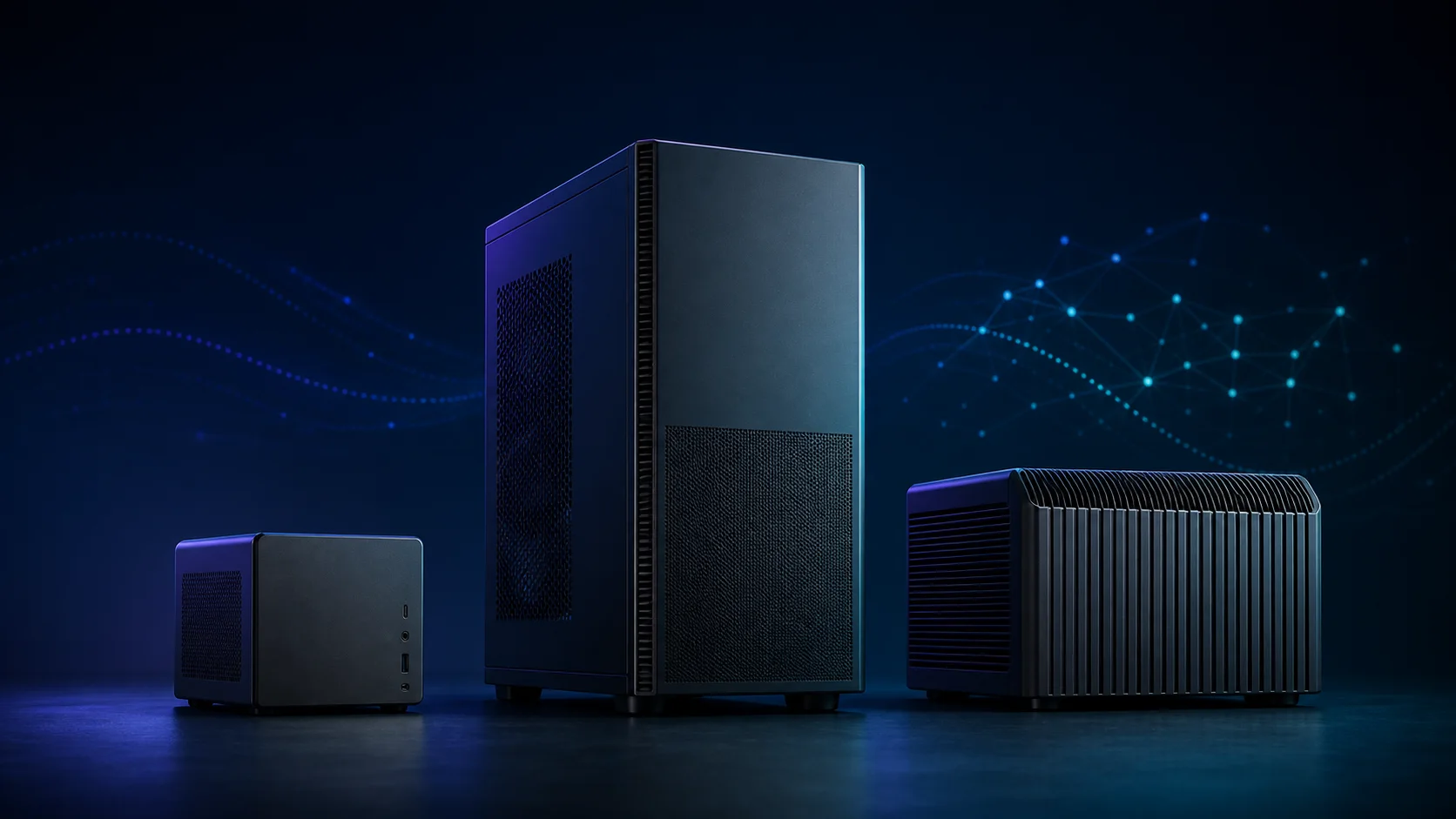
Unbranded mini PC, large GPU tower, and compact AI appliance shown side by side
Three common forms: mini PCs prioritize space and model capacity, GPU towers speed and upgrades, and dedicated AI appliances an integrated development stack.

Quick choice by workload

What is the best AI PC for your local LLM?

There is no single best local AI computer. Model size, target speed and software support lead to different systems. This shortlist maps each goal to a concrete hardware path.

Your goalSuitable hardware pathSpecific systemsWhy it fits
7B to 14B, practical entry12 to 16GB of dedicated VRAM and at least 32GB RAMChoose the GPU tierUseful headroom for many compact models and ordinary context lengths.
20B to 32B, maximum speedRTX 5090 desktop with 32GB VRAMHP OMEN 45L RTX 5090High memory bandwidth and a broadly supported CUDA path.
Large models up to 70B, compact128GB unified memoryGMKtec EVO-X2 or Beelink GTR9 ProThe large shared pool prioritizes model capacity in a small footprint.
Professional Windows workstationRyzen AI Max+ PRO with workstation supportHP Z2 Mini G1aBusiness configuration, internal power supply, Thunderbolt 4 and on-site support.
NVIDIA stack and large modelsGB10 appliance with 128GBASUS Ascent GX10CUDA-oriented development and a large memory pool; Arm/Linux must fit the workflow.

Local AI hardware requirements extend beyond a GPU or unified-memory figure. Runtime support, SSD capacity, cooling, and networking for server use all affect the right purchase; the model guides check them individually.

Specific complete systems

Which configuration fits your daily use?

These PCs differ beyond model memory. Storage layout, networking, power delivery, cooling, and memory upgrades determine whether a system works best on a desk, as a home server, or for frequent large-model use.

Best for: large models in a compact PC

GMKtec EVO-X2

Ryzen AI Max+ 395 with a large 128 GB unified memory pool. Read the model guide.

128 GB

Good for

Quantized 70B models, larger local knowledge bases, and a compact single-user model server. Two USB4 ports, Wi-Fi 7, and dual M.2 storage make the small chassis practical for a growing model library.

Limits

The LPDDR5X memory is soldered, and unified memory does not match the bandwidth of a large discrete GPU. Confirm the 128 GB / 2 TB option, your maximum UMA allocation, and runtime support.

CPU / graphics
Ryzen AI Max+ 395 / Radeon 8060S
Memory
128 GB LPDDR5X, shared
Storage expansion
2× M.2 PCIe 4.0; 2 TB included
Networking
2.5GbE, Wi-Fi 7
Ports
2× USB4, HDMI, DisplayPort, SD reader
Size / power
193 × 186 × 77 mm; external 230 W adapter
Best for: large models and fast home networking

Beelink GTR9 Pro

Ryzen AI Max+ 395, 128 GB unified memory, 2 TB storage, and dual 10GbE. Read the model guide.

128 GB

Good for

Quantized 70B models, large local knowledge bases, and a compact model server serving several devices over a fast wired network.

Limits

The LPDDR5X memory is soldered and unified memory favors capacity over peak discrete-GPU throughput. Confirm the 128 GB / 2 TB listing, maximum UMA allocation, OS support, and Radeon runtime before buying.

CPU / graphics
Ryzen AI Max+ 395 / Radeon 8060S
Memory
128 GB LPDDR5X-8000, shared
Storage expansion
2× M.2 PCIe 4.0; 2 TB included
Networking
2× 10GbE, Wi-Fi 7
Ports
2× USB4, HDMI, DisplayPort, SD reader
Best role
compact multi-client model server

Best for: support-led compact workstation

HP Z2 Mini G1a

Ryzen AI Max+ PRO 395 with 128 GB unified memory, Windows 11 Pro, and a three-year warranty. Read the model guide.

128 GB

Good for

Large quantized models, local RAG, and professional desks that benefit from Thunderbolt 4, an internal power supply, and on-site workstation support. The large pool leaves room for many 70B configurations while remaining a compact Windows PC.

Limits

The soldered memory cannot be upgraded, and Radeon runtime support still needs checking. The included 1 TB SSD is modest for several large model families; compare the final seller price with consumer Ryzen AI Max systems before paying for the workstation support package.

CPU / graphics
Ryzen AI Max+ PRO 395 / Radeon 8060S
Memory
128 GB LPDDR5X-8533, shared
Storage expansion
2× M.2 2280; 1 TB included
Networking
2.5GbE, Wi-Fi 7
Ports
2× Thunderbolt 4, 2× mini-DP, USB-C/A
Size / power
3.4 × 6.6 × 7.9 in; internal 300 W PSU

Best for: NVIDIA-native local AI development

ASUS Ascent GX10

Compact GB10 Grace Blackwell appliance with 128 GB coherent unified memory and NVIDIA's AI software stack. Read the full buying guide.

128 GB

Good for

CUDA-native inference, prototyping, fine-tuning experiments, and quantized 70B workloads that benefit from a large shared pool. DGX OS includes an Ubuntu-based NVIDIA environment, while 10GbE and ConnectX-7 support fast networked workflows.

Limits

This is an Arm/Linux AI appliance, not a general-purpose Windows gaming PC. Confirm that every required application and model format supports the platform. The configuration described here uses a 4 TB M.2 2242 SSD; confirm that capacity and the warranty region in the selected offer.

Processor / graphics
NVIDIA GB10 Grace Blackwell Superchip
Memory
128 GB LPDDR5X coherent unified memory
Storage
4 TB M.2 2242 PCIe 5.0 NVMe
OS / software
NVIDIA DGX OS, Ubuntu, CUDA stack
Networking
10GbE, Wi-Fi 7, ConnectX-7
Size / power
5.91 × 5.91 × 2.01 in; 180 W input

Best for: high-end parts in a large chassis

HP OMEN 45L

RTX 5090 configuration in a roomy tower with 64 GB of system memory.

32 GB

Good for

Fast 8B to 32B inference in a large, serviceable tower. Thunderbolt 4 and 2.5GbE are useful for external storage or serving models to other devices.

Limits

The included 64 GB uses all four DIMM slots (4×16 GB). Reaching the supported 128 GB therefore requires replacing the installed modules. The 2 TB SSD is a useful start, but a larger model library may need another drive.

CPU / graphics
Core Ultra 9 285K / RTX 5090 32 GB
Memory
64 GB DDR5-5600 (4×16 GB); up to 128 GB
Storage
2 TB PCIe 4.0 NVMe
Power
1200 W 80+ Gold PSU
Networking
2.5GbE, Wi-Fi 6E
Exact model
GT22-3090 / B91WJAA#ABA

* Paid link. We may earn a commission if you buy; your price is unchanged. As an Amazon Associate we earn from qualifying purchases. The destination page controls specifications, price, seller and delivery information.

Direct comparison

Choose by model size and practical priorities

SystemFast memoryBest fitMain limitation
GMKtec EVO-X2128 GB sharedcompact 70B use and large model capacitysoldered RAM; UMA/runtime support matters
Beelink GTR9 Pro128 GB shared70B capacity and dual-10GbE home servingsoldered RAM; verify OS, network, and runtime support
HP Z2 Mini G1a BN8E8UA128 GB shared70B capacity with Windows and workstation support1 TB included; soldered RAM; Radeon runtime
ASUS Ascent GX10128 GB coherent sharedCUDA-native development and large-model experimentsArm/Linux platform; sealed SSD; one-year warranty
HP OMEN 45L GT22-309032 GB GDDR7fast 8B–32B in a roomy towerall DIMM slots occupied; 2 TB SSD

Still unsure?

Calculate your memory need first

Model size and context matter more than a brand name. Our finder makes every assumption visible.

Open the PC Finder